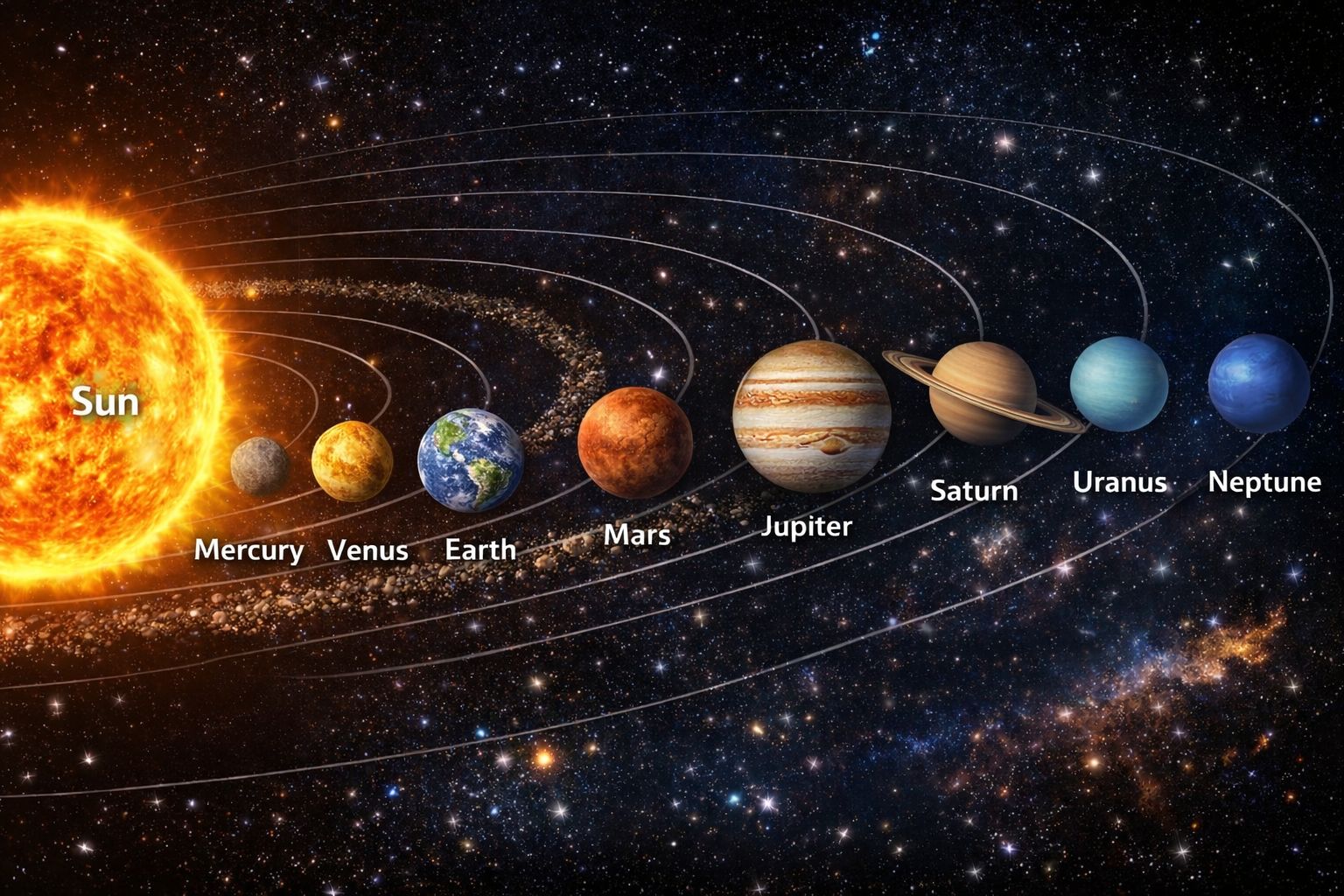
What is the Solar System?
Think of the Solar System like a very big neighbourhood in space. It includes the Sun and everything that goes around it because of its gravity.
At the centre of the Solar System is the Sun. The Sun is a very large and extremely hot ball of gas. It gives us light and heat, which makes life possible on Earth. It is also the most important part of the Solar System. It is not just the brightest object in our sky, but also the powerful force that holds everything together.
The Sun has a strong force called gravity. This gravity keeps all the planets, moons, asteroids, and comets moving around it in fixed paths. If the Sun did not have gravity, all these objects would move away and spread out into space.
Simply, Think of the Solar System as a big family where the Sun is the head, and all the planets and other space objects are its members, moving around it in fixed paths called orbits. Without the Sun, life on Earth would not exist.
Who lives in this neighbourhood?
Everything that orbits (circles) the Sun is part of the Solar System. This includes:
Moving around the Sun are eight planets:
- Mercury
- Venus
- Earth
- Mars
- Jupiter
- Saturn
- Uranus
- Neptune
Apart from planets, the Solar System also includes:
- Moons (natural satellites that orbit planets) – Natural satellites that circle the planets (like our own Moon).
- Dwarf planets – Like Pluto, which is like the small, quirky cousin of the family.
- Asteroids and Comets – These are the leftover pieces from when the Solar System was formed about 4.6 billion years ago. Asteroids are made of rock and metal, while comets are like dirty ice balls made of frozen gases, dust, and rock.
- Meteoroids – A meteoroid is a small piece of rock or metal travelling through space. They are much smaller than asteroids – some are as big as a boulder, while others are as tiny as a grain of sand. They usually break off from larger asteroids or comets. If a meteoroid enters Earth’s atmosphere and burns up, it is called a meteor (shooting star). If it reaches the ground, it is called a meteorite.
How does it stay together?
All these space objects stay together because of the Sun’s strong gravity.
Think about tying a ball to a string and spinning it around. The string stops the ball from flying away. In space, gravity works like that string — but we cannot see it.
The Sun is extremely big and heavy. In fact, it makes up about 99.8% of the total mass of the Solar System. Because it is so heavy, its gravity pulls all the planets toward it and keeps them moving in their fixed paths around the Sun.
This is why Earth does not drift away into the dark space of the Milky Way galaxy.
The 8 Planets in Order from the Sun
1. Mercury – The “Toasted” Planet
Mercury is the closest planet to the Sun. It is also the smallest planet in our Solar System. Because it is so close to the Sun, it becomes extremely hot during the day. But at night, it becomes extremely cold. This happens because Mercury does not have a proper atmosphere to hold heat.
Fun Fact: Even though Mercury is closest to the Sun, it is not the hottest planet. Venus is hotter because it has a thick atmosphere that traps heat.
Mercury is like the smallest member of the Solar System family — small, rocky, and very close to the Sun.
2. Venus – The “Greenhouse” Planet
Venus is the second planet from the Sun. It is almost the same size as Earth, which is why it is often called Earth’s “twin” or “sister planet.”
But Venus is very different from Earth. It is the hottest planet in the Solar System. This is because it has a very thick atmosphere made mostly of carbon dioxide. This thick layer traps heat, just like a greenhouse, making the planet extremely hot.
The Vibe: It is the hottest planet in the solar system. It has a thick, suffocating atmosphere that traps heat like a giant greenhouse.
Fun Fact: On Venus, the Sun rises in the West and sets in the East because Venus spins in the opposite direction compared to most planets.
Venus is roughly the same size as Earth, so it’s often called our “sister planet.”
3. Earth – The “Goldilocks” Planet
Earth is our home planet and the third planet from the Sun. It is the only planet we know that supports life.
Earth has water, oxygen, and the right temperature for plants, animals, and humans to live.
The Vibe: Everything is “just right.” Not too hot, not too cold – perfect for life.
Fun Fact: From space, Earth looks like a “Blue Marble” because 70% of it is covered by oceans.
This is our home! It’s the only place we know that has liquid water and life.
4. Mars – The “Rusty” Planet
Mars is known as the “Red Planet” because of its reddish colour. The red colour comes from iron oxide in its soil, which is basically rust. Mars is a cold and dry planet, like a desert filled with dust and rocks.
Scientists are very interested in Mars and are studying whether life ever existed there.
The Vibe: A cold, dusty world that looks rusty and empty.
Fun Fact: Mars has the tallest mountain in the entire Solar System, called Olympus Mons. It’s three times taller than Mount Everest!
Mars is known as the Red Planet.
5. Jupiter – The “King” Planet
Jupiter is the largest planet in our Solar System. It is a gas giant made mostly of hydrogen and helium. It is so huge that about 1,300 Earths could fit inside it.
The Vibe: A massive planet covered with colourful clouds and powerful storms.
Fact: Jupiter has a giant storm called the Great Red Spot. This storm has been active for more than 300 years and is bigger than Earth.
Jupiter is the biggest planet – you could fit 1,300 Earths inside it!
6. Saturn – The “Lord of the Rings”
Saturn is famous for its beautiful rings made of ice and rock. It is also a gas giant and is the second-largest planet.
The Vibe: While other planets have rings, Saturn’s are the most beautiful, made of billions of chunks of ice and rock.
Fun Fact: Saturn is very light for its size. Its density is lower than water, which means that if there were a bathtub big enough, Saturn would float!
Saturn is the second-largest planet and the most famous when it comes to appearance.
7. Uranus – The Sideways Planet
Uranus is an ice giant and one of the coldest planets in the Solar System. It has a beautiful pale blue color because of methane gas in its atmosphere.
The Vibe: It’s the rebel of the Solar System. While most planets spin upright like a top, Uranus spins on its side like a rolling ball.
Fun Fact: Uranus was the first planet discovered using a telescope.
Uranus is an “Ice Giant.” It’s freezing cold and stands out because of its unusual tilt and blue color.
8. Neptune – The “Windy” Planet
Neptune is the farthest planet from the Sun. It is also an ice giant, one of the coldest planets in the Solar System, and is known for having very strong winds.
The Vibe: It’s dark, cold, and incredibly windy. It has the strongest winds in the Solar System – even faster than the speed of sound on Earth.
Fun Fact: One year on Neptune (the time it takes to circle the Sun once) is equal to about 165 Earth years.
Neptune is the farthest planet from the Sun and is a deep, dark blue and the outermost member of our Solar System..
Comparison at a Glance
| Planet | Type | Main Feature |
|---|---|---|
| Mercury | Terrestrial | Smallest & Closest |
| Venus | Terrestrial | Hottest (Greenhouse) |
| Earth | Terrestrial | Life & Water |
| Mars | Terrestrial | Red & Dusty |
| Jupitar | Gas Giant | Largest (The King) |
| Saturn | Gas Giant | Spectacular Rings |
| Uranus | Ice Giant | Spins on its side |
| Neptune | Ice Giant | Farthest & Windiest |
A Quick “Mental Map” for Students:
If you want to remember the order of the planets from the Sun, just memorise this simple sentence (the first letter of each word matches a planet):
My Very Educated Mother Just Served Us Nachos. (Mercury, Venus, Earth, Mars, Jupiter, Saturn, Uranus, Neptune)
Types of Planets in the Solar System: Inner vs. Outer Planets
Terrestrial Planets (Inner):
The terrestrial planets are the four planets that are closest to the Sun. They are also called the inner planets.
Terrestrial planets are: Mercury, Venus, Earth and Mars.
Why are they called Terrestrial Planets?
The word ” terrestrial “ comes from the Latin word “Terra,” which means Earth.
These planets are called terrestrial because they are made mostly of rock and metal, just like Earth. They have solid surfaces, which means (with proper protection) you could stand on them.
Why Are They Earth-Like?
- They have a solid floor: You could actually walk on them! They are made of rock and metal.
- They are smaller in size – Much smaller than the giant outer planets.
- They have very few moons: Earth has one, Mars has two, and Mercury and Venus have no moons.
Special Features of Inner Planets:
- They are smaller compared to the outer planets.
- They are closer to the Sun.
- They have fewer moons.
- They do not have large ring systems.
So, you can remember it like this: Inner planets = Rocky planets near the Sun.
The Jovian Planets (Outer):
If the inner planets are the “rock stars,” the Jovian Planets are the “heavyweights” of the Solar System.
The name Jovian comes from Jove, another name for the Roman god Jupiter. So, when we say “Jovian,” we basically mean “Jupiter-like”—huge, massive, and definitely not made of rock!
What Are Jovian Planets?
The Jovian planets are the four outer planets:
- Jupiter
- Saturn
- Uranus
- Neptune
They are also called the outer planets because they are far from the Sun.
What makes them “Jovian”?
- No solid surface: Unlike Earth, these planets don’t have a solid surface(made of gas or thick icy materials) to stand on. You cannot stand on them. If a spaceship tried to land, it would sink into thick clouds and face extreme pressure.
- They are huge: You could fit hundreds (or thousands!) of Earths inside them.
- They have rings: All four Jovian planets have ring systems, and Saturn’s rings are the most famous and easiest to see.
- They have many Moons: While Earth has one, these giant planets have dozens of moons each – much more than the inner planets.
Jupiter and Saturn are called Gas Giants.
Uranus and Neptune are called Ice Giants.
The Gas Giants: Jupiter and Saturn
These are the two biggest planets in the Solar System. They are called gas giants because they are mostly made of gases like hydrogen and helium. They do not have a solid surface like Earth.
1. Jupiter: The King of Planets
Jupiter is the largest planet in the Solar System. It is so huge that more than 1,300 Earths could fit inside it.
Because of its strong gravity, Jupiter sometimes pulls in or deflects asteroids and comets. This helps reduce the number of space rocks that might hit Earth.
Key Feature:
The Great Red Spot – a storm that has been spinning for centuries.
2. Saturn: The Ringed Wonder
Saturn is famous for its massive, glowing rings. Even though Saturn is very large, it is mostly made of gas, which makes it very light for its size. In theory, if there were a huge ocean big enough, Saturn could float!
Saturn is the second-largest planet. It is famous for its beautiful and bright ring system.
Key Feature: Its Ring System, made of billions of bits of ice, dust, and rock.
Jupiter is the largest planet in the Solar System, and Saturn is famous for its beautiful rings made of ice and rock.
The Ice Giants: Uranus and Neptune
These two planets are farther from the Sun and much colder. These planets are called ice giants because they are made of gases along with icy materials like water, ammonia, and methane.
In Simple Words, Outer planets = Very big planets made mostly of gas and ice. They are much larger than the inner rocky planets. All of them have rings and many moons.
3. Uranus: The Tilted Ice Giant
Uranus is pale blue in color because of methane gas in its atmosphere.
It is very unusual because it spins on its side instead of upright. Scientists believe that a large object may have hit it long ago and caused it to tilt.
Key Feature:
It’s an extreme sideways tilt (about 98°).
4. Neptune: The Windy Ice Giant
Neptune is the farthest planet from the Sun. Because it is so far away, it takes about 165 Earth years to complete one orbit around the Sun.
Key Feature:
Supersonic Winds. The winds on Neptune are the fastest in the Solar System – reaching over 1,200 mph(miles per hour).
Uranus is known for tilting on its side, and Neptune is known for having very strong winds.
All outer planets are huge, have rings, and have many moons.
Key Differences: Inner vs. Outer Planets
| Feature | Inner Planets | Outer Planets |
|---|---|---|
| Composition | Rocky/Metallic | Gaseous/Icy |
| Size | Smaller | Massive |
| Rings | None | All have rings |
| Moons | Few or none | Many moons |
Facts About Each Planet
1. Mercury: The “Swiftest” Planet
- Size: It is the smallest planet in the Solar System. (only slightly larger than our Moon).
- Orbit: It is the closest planet to the Sun. It travels around the Sun faster than any other planet (88 days).
- Temperature: It has the wildest temperature swings – blazing hot during the day and freezing 180°C at night because it has no atmosphere to trap heat.
- Key Fact: A day on Mercury is longer than its year! It spins very slowly on its axis but zooms around the Sun. A year on Mercury is very short – only 88 Earth days!
2. Venus: The “Solar System’s Oven
- Nickname: It is often called Earth’s “twin” because it is similar in size.
- Atmosphere: Thick, toxic clouds of sulfuric acid.
- Temperature: The hottest planet (about 465°C), hot enough to melt lead.
- Key Fact: It rotates in the opposite direction compared to most planets. It spins backwards! On Venus, the Sun rises in the West and sets in the East.
3. Earth: The “Ocean Planet”
- Surface: 70% of our planet(Earth) is covered by water.
- Atmosphere: Earth is the only planet known to support life. The only planet with a breathable atmosphere (Nitrogen and Oxygen).
- Protection: Our magnetic field protects us from solar radiation.
- Key Fact: We are the only planet not named after a Greek or Roman god – “Earth” is just an Old English/German word for “ground.”
- Moons: It has one natural satellite – the Moon.
4. Mars: The “Red Desert”
- Color: It looks red because of rusty iron dust in its soil.
- Geography: Home to Olympus Mons, the largest volcano in the solar system, and Valles Marineris, a canyon as long as the USA.
- Moons: Two tiny moons named Phobos and Deimos.
- Key Fact: Scientists have found evidence that liquid water once flowed here billions of years ago.
5. Jupiter: The “Vacuum Cleaner”
- Jupiter is the biggest planet.
- Mass: Twice as massive as all the other planets combined!
- Storms: The Great Red Spot is a hurricane-like storm that has lasted for over 300 years.
- Moons: It has more than 90 moons, including Ganymede, which is bigger than Mercury.
- Key Fact: Jupiter spins so fast that a “day” there lasts only about 10 hours.
6. Saturn: The “Ringed Jewel” of the Solar System
- It is the second-largest planet.
- Rings: Saturn is famous for its beautiful rings. It has seven main rings made of billions of chunks of ice and rock.
- Density: It is mostly made of gas and is so light that it would float in water.
- Moons: It has the most moons in the solar system (146).
- Key Fact: Its biggest moon, Titan, has a thick atmosphere.
7. Uranus: The “Ice Giant on its Side”
- Tilt: It rotates at a 98-degree angle – it basically rolls around the Sun like a ball.
- Colour: Methane gas in its atmosphere gives it a beautiful blue-green colour.
- Temperature: It is very cold. One of the coldest places in the solar system.
- Key Fact: Like Saturn, it has rings (13 of them), but they are very thin and dark.
8. Neptune: The “Windiest World”
- Distance: The farthest planet from the Sun (about 4.5 billion km away).
- Colour: It is deep blue in colour.
- Winds: It has the strongest winds in the Solar System. Home to the fastest winds ever recorded – up to 2,100 km/h!
- Discovery: It was the first planet discovered using mathematics before being seen in a telescope.
- Key Fact: A “year” on Neptune lasts 165 Earth years. Since its discovery in 1846, it has only finished one single orbit around the Sun!
Planet Facts: A Closer Look
- Mercury: The smallest planet, closest to the Sun; no atmosphere.
- Venus: The hottest planet (thanks to the greenhouse effect), “Earth’s Twin.”
- Earth: The only planet with liquid water and life.
- Mars: Known as the “Red Planet” due to iron oxide (rust) on its surface.
- Jupiter: The largest planet; it has the “Great Red Spot” (a massive storm).
- Saturn: Famous for its spectacular ring system made of ice and rock.
- Uranus: The “sideways planet” because it rotates on its side.
- Neptune: The farthest planet, known for its intense supersonic winds.
Important Solar System GK Facts for Exams
- The Sun is at the centre of the Solar System.
- There are 8 planets in our Solar System.
- The Solar System is about 4.6 billion years old.
- The four inner planets are rocky, and the four outer planets are giant planets.
The Extremes (Biggest, Smallest, Hottest)
- The Hottest Planet: Venus (Even though Mercury is closer to the Sun, Venus’s thick atmosphere traps heat like a furnace, making it hotter (465°C))
- The Smallest Planet: Mercury (It’s just a little bit bigger than Earth’s Moon!)
- The Largest Planet: Jupiter (You could fit more than 1,300 Earths inside it.)
- The Coldest Planet: Uranus (While Neptune is further away, Uranus holds the record for the coldest temperature ever measured on a planet.)
The “Special Titles” (Nicknames)
- Earth’s Twin: Venus (It is called this because its size, mass, and density are very similar to Earth’s.)
- The Red Planet: Mars (Its surface is covered in iron oxide (rust), giving it a reddish glow.)
- The Sideways Planet: Uranus (It’s the only planet that rotates on its side.)
- The Morning/Evening Star: Venus (Because it is so bright, it is often visible just before sunrise or just after sunset.)
Moons and Space Rocks
- The Largest Moon: Ganymede (orbits Jupiter). (It is actually bigger than the planet Mercury!)
- The Moon with an Atmosphere: Titan (orbits Saturn). (It’s the only moon known to have thick clouds and a dense atmosphere.)
- The “Shooting Star”: This is a Meteor. (It’s just a space rock burning up as it enters Earth’s atmosphere.)
- The Asteroid Belt: A massive “ring of rocks” located between Mars and Jupiter. (It separates the rocky inner planets from the gas giants.)
Space Records
- The Tallest Mountain: Olympus Mons on Mars. (It is the largest volcano in the Solar System and is about 2.5 times taller than Mount Everest.)
- The Shortest Day: Jupiter. (It spins so fast that a full day (one rotation) lasts only about 10 hours.)
- The Longest Year: Neptune. (Because it is so far away, it takes about 165 Earth years to circle the Sun once.)
- The Planet that would Float: Saturn. (It is mostly made of gas and is less dense than water. If you had a bathtub big enough, Saturn would float in it!)
The “Pluto” Question
- Is Pluto a planet? Not anymore. (Since 2006, Pluto has been classified as a “Dwarf Planet” because it hasn’t “cleared its neighbourhood” of other space debris.)
The Sun Facts🌞
- The Sun makes up 99.8% of the total mass of the Solar System.
- Around 1 million Earths could fit inside the Sun!
- Sunlight takes about 8 minutes to reach Earth.
Planet Facts You May Not Know🪐
- A day on Venus is longer than its year!
- Jupiter has a day that lasts only about 10 hours, even though it is the biggest planet.
- Saturn is so light that it could float in water (if there were a giant ocean big enough!).
- Uranus rotates on its side, which means its seasons are very unusual.
- Neptune has winds that move faster than the speed of sound.
- Mars has the largest volcano in the Solar System, called Olympus Mons.
- Mercury has no atmosphere to trap heat, so temperatures change extremely from day to night.
Earth Special Facts🌍
- Earth is not a perfect sphere – it is slightly flattened at the poles.
- Earth’s Moon is slowly moving away from Earth every year.
Other Amazing Facts🌠
- There are millions of asteroids in the asteroid belt between Mars and Jupiter.
- The Solar System is moving through space at about 828,000 km per hour around the centre of our galaxy.
- The Solar System is part of the Milky Way galaxy.
- One year on Neptune equals about 165 Earth years.
Solar System Surprising Facts – MCQs
1. Which planet has a day longer than its year?
A) Mercury
B) Mars
C) Venus
D) Neptune
Answer: C) Venus
2. Which planet is so light that it could float in water (theoretically)?
A) Jupiter
B) Saturn
C) Uranus
D) Mars
Answer: B) Saturn
3. The largest volcano in the Solar System is located on which planet?
A) Earth
B) Mars
C) Venus
D) Mercury
Answer: B) Mars
4. Which planet has the fastest winds in the Solar System?
A) Jupiter
B) Neptune
C) Saturn
D) Earth
Answer: B) Neptune
5. How long does sunlight take to reach Earth (approx)?
A) ~2 minutes
B) ~5 minutes
C) ~8 minutes
D) ~12 minutes
Answer: C) ~8 minutes
6. Which planet rotates on its side?
A) Mars
B) Uranus
C) Neptune
D) Mercury
Answer: B) Uranus
7. Which planet has the shortest day (about 10 hours)?
A) Jupiter
B) Earth
C) Venus
D) Mars
Answer: A) Jupiter
8. The Solar System is part of which galaxy?
A) Andromeda
B) Black Eye Galaxy
C) Whirlpool Galaxy
D) Milky Way
Answer: D) Milky Way
9. Which planet is known as the ‘Red Planet’ because of its rusty soil?
A) Venus
B) Mars
C) Jupiter
D) Saturn
Answer: B) Mars
10. Even though it isn’t the closest to the Sun, which planet is the hottest in our Solar System?
A) Mercury
B) Mars
C) Venus
D) Jupiter
Answer: C) Venus
11. Which planet is the largest in the Solar System?
A) Earth
B) Neptune
C) Saturn
D) Jupiter
Answer: D) Jupiter
12. Which planet is famous for its bright and beautiful rings?
A) Uranus
B) Saturn
C) Neptune
D) Mars
Answer: B) Saturn
13. Which planet is known as the “Sideways Planet” because it rotates on its side?
A) Neptune
B) Jupiter
C) Uranus
D) Mercury
Answer: C) Uranus
14. What is the smallest planet in our Solar System?
A) Mars
B) Mercury
C) Venus
D) Neptune
Answer: B) Mercury
15. Which planet is farthest from the Sun?
A) Uranus
B) Saturn
C) Neptune
D) Pluto
Answer: C) Neptune
16. Which region of space rocks lies between Mars and Jupiter?
A) The Kuiper Belt
B) The Oort Cloud
C) The Asteroid Belt
D) The Saturn Rings
Answer: C) The Asteroid Belt
17. How many planets are there in our Solar System?
A) 7
B) 8
C) 9
D) 10
Answer: B) 8
Quick Faqs
1. Which is the hottest planet?
Venus (not Mercury!)
2. Why is Pluto not a planet?
In 2006, scientists reclassified Pluto as a “Dwarf Planet.”
3. Which planet is the closest to the Sun?
Mercury is the closest planet to the Sun, sitting at an average distance of about 57.9 million kilometres.
4. Which planet has the most moons?
As of recent discoveries, Saturn holds the record with 146 moons, followed by Jupiter.
5. What is the “Great Red Spot”?
The Great Red Spot is a massive, high-pressure storm on Jupiter. It is like a hurricane that has been spinning for over 300 years and is larger than the entire planet Earth!
6. How old is the Solar System?
Scientists estimate that our Solar System formed approximately 4.57 to 4.6 billion years ago from a giant cloud of gas and dust.
7. Can we live on Mars?
Currently, humans cannot live on Mars without advanced technology. It has a very thin atmosphere (mostly Carbon Dioxide), is extremely cold, and has no liquid water on the surface. However, space agencies like NASA and ISRO are studying ways to send humans there in the future.
8. What is the difference between a Galaxy and a Solar System?
A Solar System is a single star (the Sun) and the objects orbiting it. A Galaxy (like the Milky Way) is a massive collection of billions of stars and their solar systems.
Conclusion
The Solar System is an amazing and fascinating part of space. It includes the Sun, eight planets, their moons, and many other space objects. Each planet is different and special in its own way – some are rocky, some are giant balls of gas, and some are extremely cold and far away.
By learning about the Solar System, we understand more about our own planet, Earth and the universe around us. It also helps in school exams, quizzes, and competitive tests.
Space is full of wonders, and the Solar System is just the beginning of our journey to explore the universe. 🌌✨
🚀 Join the Conversation!
We hope this guide helped you master the facts about our 8 planets.
- Which planet would you visit if you had a spaceship?
- Did any of these GK facts surprise you?
Let us know in the comments below, and don’t forget to share this post with your friends to help them ace their next science quiz!
You May Also Like
- Chandrayaan 3 vs Chandrayaan 4🌙: Mission Facts & Interactive Quiz🌍
- 8 Planets of the Solar System🪐: Interesting Facts, Order, and GK Quiz for Students🌠
- 50+ Simple GK for Kids in English with Answers
- 45 Science GK questions & Answers🧠 with Explanation | Basic to Advanced 💯
- 50 Important 💯 – MP GK Questions in English with Answers