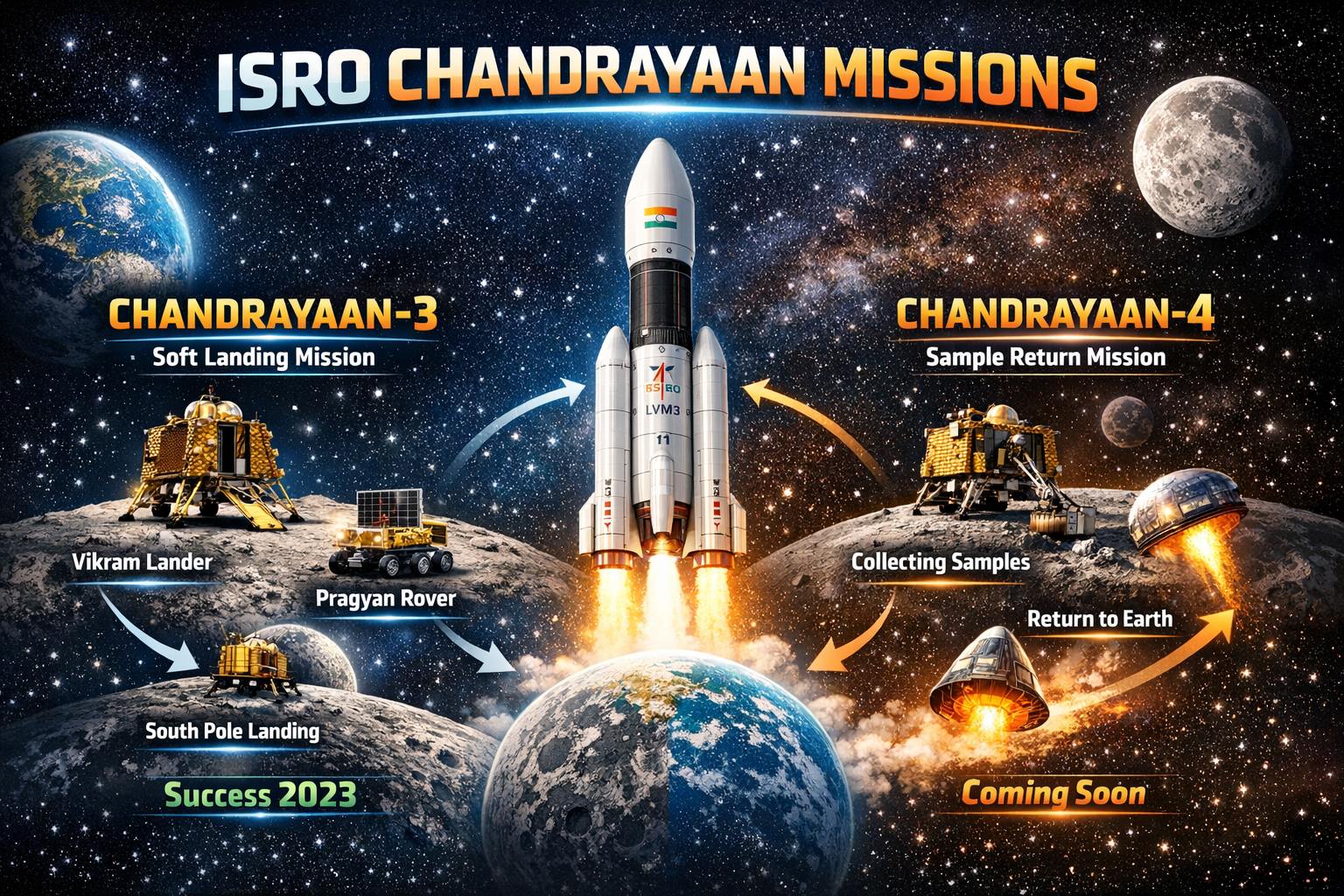
Chandrayaan 3 vs Chandrayaan 4 is one of the most exciting topics in India’s space journey. Chandrayaan-3, India’s third lunar mission, created history on August 23, 2023, when India became the first country to land near the Moon’s South Pole.
It was a proud moment for the entire nation. But the journey doesn’t stop there. ISRO is now preparing for something even bigger. The upcoming Chandrayaan-4 mission is expected to be more ambitious, with plans to take India a step further in lunar exploration.
But is this enough? No, just landing on the Moon is not our final goal. It is only the beginning.
Landing successfully has given us confidence and built a strong foundation. We have proven that we can reach the Moon safely.
Now the next step is bigger – collecting samples, studying them carefully, and searching for clues about the possibility of life and future human presence.
Step by step, we are not just visiting the Moon anymore – we are moving closer to understanding it. And one day, this journey may even help humans live beyond Earth.
If you are a student or a space enthusiast, this guide will explain the key differences, the new technologies, and what India aims to achieve next. Let’s begin –
What was Chandrayaan-3? (The Success Story)
Chandrayaan-3 was a “Landing & Roving” mission. Its primary goal was to prove that India could safely land a spacecraft on the Moon and move a rover on its surface.
- Lander: Vikram
- Rover: Pragyan
- Key Achievement: Confirmed the presence of Sulphur and other elements on the Moon.
Chandrayaan-3 is India’s third lunar mission launched by the Indian Space Research Organisation (ISRO).
Launch Details of Chandrayaan 3
- Launch Date: 14 July 2023
- Launch Vehicle: LVM3
- Landing Date: 23 August 2023
- Landing Site: Near Moon’s South Pole
Mission Objective – The mission had three important goals:
The main goal was:
- To demonstrate a safe and soft landing on the Moon
- Deploy the rover and show that it can move on the lunar surface.
- To conduct scientific experiments (Lunar soil composition, Surface temperature, Presence of elements like sulphur)
What Made Chandrayaan-3 Historic?
India became:
- The first country to land near the Moon’s South Pole
- The fourth country to successfully soft-land on the Moon after:
- United States
- Russia
- China
Components of Chandrayaan-3
- Vikram Lander
- Pragyan Rover
- Propulsion Module
The rover worked for one lunar day (about 14 Earth days) and conducted experiments on lunar soil and temperature.
Key Scientific Learnings from Chandrayaan-3
- Confirmed presence of sulphur near the lunar surface
- Measured surface temperature differences
- Studied lunar soil composition
- Demonstrated India’s precise landing technology
This strengthened India’s position in global space research.
Vikram Lander | Pragyan Rover |Propulsion Module Explained
What is a Lander? (Example: Vikram Lander)
A lander is a spacecraft designed to safely land on the surface of another planet or the Moon.
In Chandrayaan-3, the lander was named Vikram.
What Does a Lander Do?
- Carries scientific instruments
- Makes a soft landing
- Places the rover on the surface
- Studies the surface conditions
Why is a Lander Important?
Landing on the Moon is very difficult because:
- There is no atmosphere to slow down the spacecraft.
- The surface is uneven and rocky.
- Timing and speed must be perfect.
If landing fails, the entire mission can fail.
So the lander is one of the most critical parts of any Moon mission.
Used In Other Missions
Many countries use landers:
- NASA Moon missions
- Russian Luna missions
- Chinese Chang’e missions
So yes — a lander is a common device in planetary missions, not only for Chandrayaan.
What is a Rover? (Example: Pragyan Rover)
A rover is a small robotic vehicle that moves around on the surface of the Moon or Mars.
In Chandrayaan-3, the rover was named Pragyan.
What Does a Rover Do?
- Moves on the surface
- Collects soil data
- Takes photos
- Checks minerals
- Sends information back to Earth
Think of it like a remote-controlled science robot exploring another world.
Why is a Rover Important?
Because:
- It can travel to different locations.
- It gives more data than a lander alone.
- It helps scientists understand soil, temperature, and minerals.
Without a rover, exploration is limited to just one spot.
What is a Propulsion Module?
A propulsion module is the part of the spacecraft that provides power and movement in space.
It is like the engine system of the mission.
What Does It Do?
- Pushes the spacecraft from Earth orbit toward the Moon
- Adjusts direction
- Controls speed
- Keeps communication systems powered
In simple words, it takes the spacecraft from Earth to its destination.
Why is It Important?
Without propulsion:
- The spacecraft cannot travel.
- It cannot change direction.
- It cannot reach the Moon.
It works before landing. After the lander separates, its job is usually complete.
What is Chandrayaan-4? (The Next Frontier)
Unlike its predecessor, Chandrayaan-4 is a Sample Return Mission. This means ISRO won’t just land on the Moon – it will collect Moon rocks and soil and bring them back to Earth.
Chandrayaan-4 is India’s upcoming lunar mission, planned as a sample return mission.
Expected Objectives
- Land on the Moon
- Collect lunar soil/rock samples
- Bring samples back to Earth
This mission will be more complex than Chandrayaan-3 because returning from the Moon is technically very challenging.
Why is Chandrayaan-4 Important?
If successful, India will join the elite group of countries that have brought Moon samples back to Earth.
Currently, only:
- United States
- Russia
- China
have successfully completed lunar sample return missions.
Key Differences: Chandrayaan 3 vs Chandrayaan 4
| Feature | Chandrayaan-3 | Chandrayaan-4 |
|---|---|---|
| Mission Type | Soft Landing & Roving | Sample Return (Bring soil to Earth) |
| Launch Method | Single LVM3 Rocket | Dual Launch (Two separate rockets) |
| Complexity | High (Landing only) | Very High (Space Docking required) |
| Estimated Launch | Launched (2023) | 2027 – 2028 (Planned) |
| Status | Successfully Completed | Planned |
| Historic Achievement | First landing near South Pole | Upcoming Mission (Achievement Yet to Be Determined) |
Why this mission matters for India
Bringing samples back to Earth allows scientists to study Moon soil in high-tech labs. This is a crucial step before India sends its first human to the Moon (Gaganyaan), which is targeted for the late 2030s.
Interactive Quiz: How well do you know ISRO?
Q1. Chandrayaan-3 landed near which region of the Moon?
A) Equator
B) North Pole
C) South Pole
D) Dark Side
Answer: C) South Pole
Q2. Which organisation launched Chandrayaan-3?
A) NASA
B) ISRO
C) ESA
D) Roscosmos
Answer: B) ISRO
Q3. What is the main goal of Chandrayaan-4?
A) To build a house on the Moon
B) Build Moon station
C) To bring Moon samples back to Earth
D) Send humans
Answer: C) To bring Moon samples back to Earth
Q4. India became the ____ country to soft-land on the Moon.
Answer: Fourth
Q5. The rover of Chandrayaan-3 was named?
Answer: Pragyan
Q6. Which mission made India the 1st country to land near the Moon’s South Pole?
A) Chandrayaan-1
B) Chandrayaan-2
C) Chandrayaan-3
Answers: C) Chandrayaan-3
Q7. How many rockets will be used to launch Chandrayaan-4?
A) One
B) Two
C) Three
Answers: B) Two
Q8. What is the name of the “Space Docking” experiment ISRO is performing?
A) Gaganyaan
B) Aditya-L1
C) SPADEX(Space Docking Experiment)
Answers: C) SPADEX(Space Docking Experiment)
Quick Revise – Chandrayaan 3 vs Chandrayaan 4
What Chandrayaan-3 Actually Did
- It landed safely on the Moon.
- The Pragyan rover moved on the surface.
- It studied the soil and elements using onboard instruments.
- It analyzed things like sulphur and surface temperature.
But the rover only studied the soil there itself.
It did not pick up samples and return them to Earth.
In One Simple Line:
Chandrayaan-3 studied the Moon’s soil –
but it did not bring any soil back.Sample return is expected in future missions (like Chandrayaan-4).
You May also Like
- Chandrayaan 3 vs Chandrayaan 4🌙: Mission Facts & Interactive Quiz🌍
- 8 Planets of the Solar System🪐: Interesting Facts, Order, and GK Quiz for Students🌠
- 50+ Simple GK for Kids in English with Answers
- 45 Science GK questions & Answers🧠 with Explanation | Basic to Advanced 💯
- 50 Important 💯 – MP GK Questions in English with Answers